Origin
The Allium family, which belongs to the Liliaceae family according to the older classification and the Alliaceae subfamily of the Amaryllidaceae family in the newer system, grows mainly in the temperate zone of the Northern Hemisphere and is quite large – according to various sources, 660-750 species. 138 species grow naturally in China, 50 of which are endemic. 6 species are native to Estonia. Alliums are perennial herbaceous plants with rhizomes or bulbs that have been transformed into underground shoots . All parts of most allium species are edible and the fresh plant has the characteristic smell of garlic, leek or onion. As a medicinal plant, alliums have a strong antibacterial effect, and the aromatic substances have anti-inflammatory, anti-cancer, anti-parasitic and anti-thrombotic effects. At the same time, alliums are on the list of poisonous plants in the world, as they can cause poisoning symptoms in sensitive people – vomiting, nausea and diarrhea. Moderation could be the key word here.
Options
Despite the great diversity of species, the choice remains significantly narrower when it comes to decorativeness. Fortunately, there are species suitable for quite different conditions. From 10-20 cm in height, suitable for alpine gardens, to beauties with large flower heads that reach even 150-200 cm. Suitable species can also be found in damp and shady forest floors. The main flowering period is from late May to early July. The color range varies in all sorts of shades in the fields, mixing red, blue and white in the color palette - from very light pink to deep purple. There are also quite white, blue and yellow species. There are often large variations in color within a species, and depending on the place of growth, the height can also be quite different.
About upbringing
Growing in the wild, they often do not need excessive watering in the home garden. Most species prefer fertile clay soil with good drainage. Drainage is especially important during the dormant period. They should be fertilized quite carefully or not at all, and otherwise they do not require any special care. All bulbs need enough moisture in the spring, but species that come from dry, arid regions must definitely be planted in a very well-drained location and protected from frost in snowless winters. They will not survive our winter in excessively wet locations ( Turkmen bulb A. christophii , Schubert bulb A. schubertii). Bulbs with rhizomes, on the other hand, need a moderately moist location throughout the growing season. Bulbs are good “lazy person’s” flowers, because once planted, they can successfully manage in the same location for years. Depending on the size of the bulb, they are planted to a depth of 5-15 (30) cm in ordinary garden soil. If the bulbs have grown into a too dense clump and are showing a decrease in flowering, they should be dug out of the ground and replanted separately after flowering. Diseases and pests are usually not very common. However, rotting of the bulbs and fungal diseases may occur in rainy summers. Overfertilized plants in an unsuitable growing location for the species are more susceptible to disease.
Decorative species:
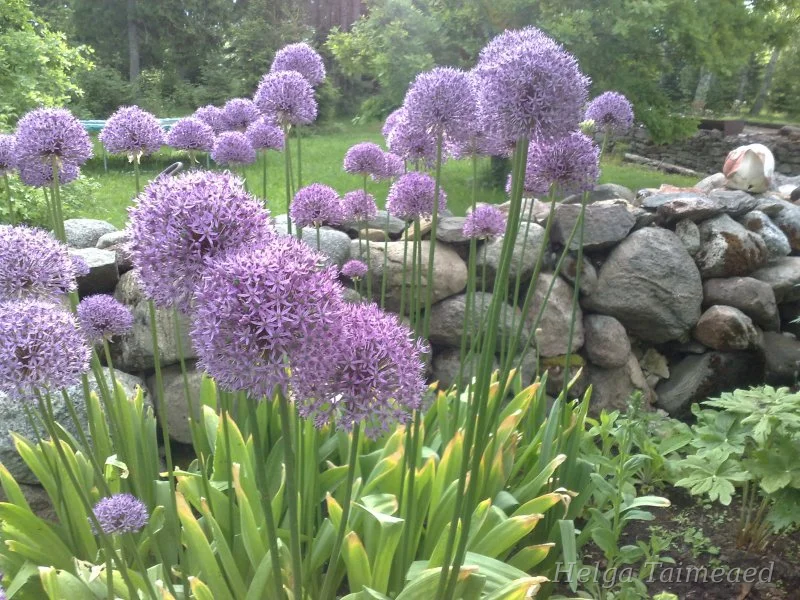
Allium hollandicum (A. hollandicum) 'Purple Sensation' Allium hollandicum was originally described in the Netherlands as a garden hybrid, but was later found to be a natural species from Iran. The most widely sold allium in the world. Height 80 cm, flower diameter 8 (10) cm, purple-red inflorescence. Since the seed produces offspring of different shades, true varieties can only be obtained from vegetative propagation.

Stemmed arum (A. stipitatum) 'Mount Everest' Leaves erect, hairy underneath, strap-like, broad. Flowers bloom in early June and flower diameter 10-12 cm. The best among white-flowered varieties. Height ca. 90-125 cm. Some literature suggests that it is a hybrid of stemmed arum and aflauntunense arum (A. aflantunense) . However, genetic analysis has determined that it is not an interspecific hybrid. Requires a dry, well-drained growing site during dormancy. Stemmed arum grows naturally in Central Asia, Pakistan, and Afghanistan.
Giant garlic (A. giganteum ) Grows on the slopes of the foothills of Central Asia, Afghanistan and Iran. The foliage emerges very early (night frosts can pinch it), but it has a later flowering period (late June-July), with a large dense inflorescence with a diameter of 10-15 cm. First described in 1883.
'Gladiator' – a hybrid of Dutch onion and probably stem onion. Height up to 150 cm, blooms in June, sterile purple inflorescence ø up to 15 cm. Breeder W.Hey1981.
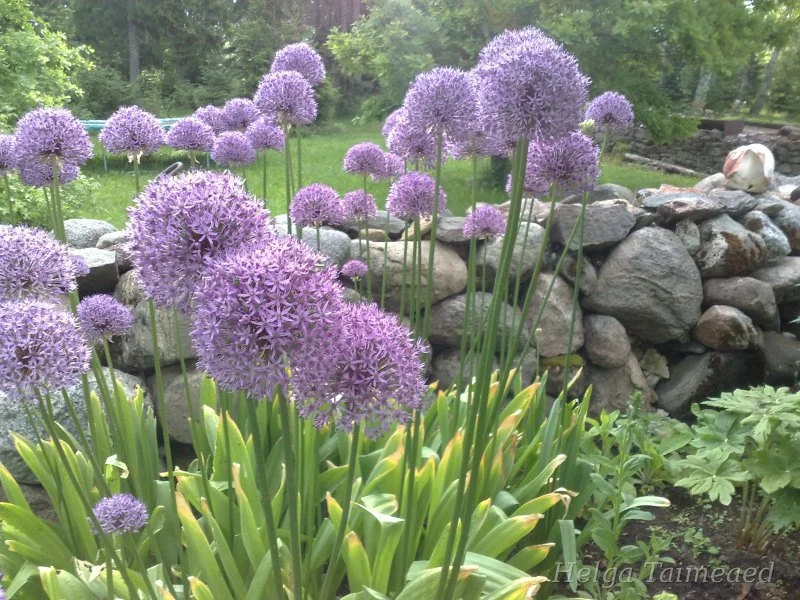
'Beau Regard's' – According to various sources, a hybrid of giant or towering onion (A. macleanii) and Turkmen onion from 1959. The 90 cm high flower stalk bears a large dense inflorescence. Beautiful glossy leaves
'Round and Purple' pastel purple ø 15 cm flowers bloom at the end of June. Height 90 cm. Long flowering period. Could be planted in a slightly more sheltered spot.
'Ambassador' – 90-120 cm tall and with a very strong flower stem, tolerates strong winds well, particularly dense and large inflorescence with purple sterile flowers ( ø up to 20 cm) . Good cut flower.
'Globemaster' Variety from 1971, bred by J. Bijl. Parents are Turkmen sedge and towering sedge. Large star-shaped flowers bloom at the end of June, forming a dense ball. As the inflorescences gradually open, the ball becomes increasingly larger, reaching 15-20 cm in diameter. Mid-summer bloomer, very long flowering period, height approx. 80 cm.
'Forelock' is an exciting looking variety from 2009. I found a striking comparison between Tom Hanks' Chuck's friend Wilson and 'Forelock' from the movie "Washed Ashore". It has bloomed in my garden for 2 years and both times the height has been about 140-150 cm. It has not propagated vegetatively yet, but perhaps it is too early to say anything about that. In 2014, I also managed to collect some seeds.
Bulgarian honey garlic (Nectascordum siculum subsp. bulgaricum) This Bulgarian subspecies of Sicilian honey garlic grows in the European part of Turkey, Bulgaria, Moldova and eastern Romania. Triangular foliage, which has a very unpleasant smell, flower stalk about 90 cm. The hanging waxy bells are quite large and pink-greenish-white. Blooms in midsummer. At the end of flowering, the flower bracts turn upright from their hanging position. It has grown in my garden for 15 years and has not produced seeds during this time. Easy to propagate vegetatively.
Persian honeysuckle (Nectascordum tripedale) This is a Red Book species. Only 2 locations are known from the former NL. Leaves triangular, ca 60 cm long. Flower stalk 100-150 cm high. The inflorescence consists of pink bells, which are arranged in fairly dense clusters. It gives very little vegetative propagation. It takes 7 years from seeds to flowering.
Turkmenia (A. cristophii) First described in 1884. Native to the rocky mountain slopes of Central Asia, Iran and Turkey at an altitude of 1000-2000 m. Height 20-60 cm. The diameter of the sparse inflorescence with uniform large metallic luster and star-shaped flowers reaches 25-40 cm, the diameter of each individual flower is 2-4 cm. Definitely needs a drier, well-drained growing site. Flowering time second half of July. Widely used for crossing and, among other things, one of the parents of the varieties 'Globemaster', 'Beau Regard'.
A. obliquum Naturally occurs in Romania, the Volga region, the Urals, Kazakhstan, Kyrgyzstan, Central and Western Siberia, and Northwestern China. The foliage resembles garlic in appearance and taste, height 60-130 cm. A rare color among alyssums. Blooms in July, ø 4-6 cm, prefers a wetter location. As a hardy species, it can also cope with poor conditions, but then the inflorescence will be smaller. The flowers can also be used as cut flowers.
Goldenrod (A. moly) grows naturally in France and Spain. Blue-green foliage. Fairly large yellow flowers are in flat inflorescences, bloom in June and remain decorative for 3-4 weeks. Semi-shady, moderately humid growing location. Reproduces well vegetatively. Height 15-40 cm. Also suitable for growing in lawns. Lime-loving.
Makhachkala lauk (A. grande) The species was first described in 1894 by the famous botanist Lipsky. This extremely rare, endangered species grows naturally only around Makhachkala, the capital of Dagestan. Pale green foliage, pink inflorescences. Height of inflorescences 80 cm, foliage 50 cm. In my garden since 2009. In the spring of 2014, a warm early spring attracted them to grow and then a long, snowless cold took them with it. Fortunately, there are still seedlings, but it will be some time before new flowers appear.
Karatau lauk (A. karataviense) is a completely cold-resistant species for sunny and dry growing sites during the dormant period. It tolerates poor soil. Usually 2-3, rarely 4 bluish-green wrinkled leaves, which remain decorative until the seeds ripen. When dormant, the leaf tips are purple-red. The dense inflorescence “sits” directly in the nest between the leaves. The inflorescence can have quite different diameters and heights within the species - 15-25 cm. Clones with a very short flower stalk are especially decorative. Flowering lasts about 3 weeks, the ripening seed pods are also very decorative. The inflorescence color varies from almost white to pink, but specimens with a red tint have also been found. It is not suitable for food due to the high saponin content. It reproduces mostly only by seeds.
Karatau lauk (A. karataviense) 'Ivory Queen' Foliage pure green when blooming without the characteristic reddish leaf tip. Pure white flowers. Foliage persists until fruit ripening. Unlike the main species, it also reproduces vegetatively.
Pskemense (A. pskemense) The species was first described by the Russian botanist BA Fedchenko in 1905. It is an endemic species growing in the western Tien Shan mountains of Central Asia along the Aksu, Ugem, Pskem rivers and their tributaries. When blooming in spring, the leaves resemble thick fingers, the flower spikes are half as high as the leaves (40-80 cm). Dense white 8 cm ø flower heads bloom in late July-August. Both the leaves and bulbs are edible. It has been studied that the germination of seeds is only 1-3%, 75% of seeds in nature are damaged by insects and 15% have a poorly developed endosperm. They bloom only 4-7 years after sowing. It can be propagated vegetatively much more successfully.
Tuberous onion (A. tuberosum) – a mild-tasting, flat-leaved bulbous plant bears beautiful white, hemispherical inflorescences from late July until frost and remains decorative from spring to late autumn. Very mild and pleasant in taste. Loves moisture, also suitable for a shady location. Very appreciated in the ornamental and commercial garden. The inflorescences are also delicious. Since it is a late bloomer, the seeds do not have time to ripen and there is no fear of becoming a weed.
Longus lauk (A. nutans ) - Grows in the steppes and rocky slopes of the southern Urals, Mongolia and northwest China. Very drought-resistant, with broad strap-shaped leaves, the bush bears pinkish-violet, 30-60 cm high inflorescences in June-July. Longus flower buds are decorative even before they bloom. Young leaves are juicy and milder, later the taste is quite sharp.
Ochota lauk (A. ochotense ) A completely cold-resistant species with permanent foliage resembling lily of the valley leaves. Decorative leaves 3-9 cm wide, 12-20 cm long. Pale greenish-white or slightly pinkish inflorescences in June-July. Height 50 cm. The foliage remains decorative until the end of summer. A good growing location is moist, semi-shaded, fertile. The leaves can be used both fresh and salted - this is how it is done in its homeland in the Far East, along the Sea of Okhota, in Kamchatka, Sakhalin, the Kuriles, Japan, North Korea and North China.
Siberian chives (A. schoenoprasum var sibiricum ) - almost half as tall and "more productive" than the common chives common in our country, the height of the inflorescences is 60 cm. It should be cut back before the seeds ripen - then it will immediately grow fresh and more pleasant-tasting foliage and weeding is avoided. Chives are well suited to moist, even shady, growing areas. The seeds are good to use in foods, dried and ground, or used for germination. The inflorescences are also very good to use in cooking. The flowers, cut when half-ripe, remain decorative in a vase for quite a long time.
Chives (A. schoenoprasum) 'Rising Star' is a low variety with gray-green foliage and reddish-pink flowers. Also suitable for growing in containers.
Chives (A. schoenoprasum 'Corsican White') pure green, slightly ruffled foliage, white flowers. Height 15-20 cm, about half as tall as the similar variety 'Wellington White'.
The type subspecies of the common yarrow (A.senescens ssp senescens ) – The bulbs are attached to a short rhizome. The light green foliage has a pleasant mild taste and remains decorative and edible throughout the season. It blooms with light pinkish-purple, hemispherical, 5 cm diameter inflorescences in July-August. The height of the inflorescences is 30-60 cm. In nature, the type subspecies is found in the areas around Lake Baikal, in Buryatia, Eastern Mongolia, Korea and Northeast China. Since the common yarrow has been divided into many small species by botanists, there is a lot of confusion in distinguishing them.
The blue-gray variant of the sedge (A. senescens ssp glaucum ) is a low, slightly curly bush with gray-blue flat leaves, the purple-pink flower stalks that bloom in August remain about 20 cm high. The taste is duller than the previous one. Very decorative in large groups on the edges of plantings and in rockeries. As a bloomer in August-September, it brings long-lasting joy to the end of summer. As a late bloomer, the seeds have not ripened in my garden. It can be propagated vegetatively.
Narcissus-flowered aster (A. narcisissiflorum) – Grows at an altitude of 800-2300 m in the southwestern part of the Alps in France. Flowering lasts from late June to July for up to 3 weeks. Height 15-35 cm. Flower color varies mostly from purple-purple to light pink, there are 2-10 fairly large bells in the inflorescence. Requires moisture, but good drainage. Very similar to the beautiful aster (A. insubricum). The difference is that at the end of flowering, the fruit aster remains hanging, while in the narcissus-flowered aster they always twist themselves upright. The petals are narrower and there are more flowers in the inflorescence. The bract of the inflorescence can be divided into 2-3 parts.
Beautiful lauk (A. insubricum) Grows in the Italian Alps at an altitude of 800-2100 m on calcareous soil. 5-8 flower bells in the inflorescence. Flower 1 cm long. Color also varies mostly from purple to light pink. Inflorescence bract usually 1-parted. Flower bracts always remain intact until the seeds ripen. Tolerates moisture satisfactorily with adequate drainage.
This brief introduction has only covered a small part of the wonderful ornamental representatives of the onion family. It is certainly a rich family that is easy to grow and worth experimenting with more, both in the vegetable garden and as ornamental plants. No matter which side appeals to you more, you have got a plant “two in one”.