(Published in the Postimees supplement "Rural Promoter" September 2015)
Sometimes I hear flower lovers complain that there are too few flowers in their flower beds from the end of July. When I ask them if they have time to visit garden centers or small nurseries/plant growers in the summer, I usually get a negative answer. But they can definitely give you good advice and suggestions for creating exciting combinations - always in such a way that you can find the right plant for the desired growing location and also see the flowers all season long. I would definitely encourage you to plan and start planting now, because a rooted potted plant can be planted as long as the shovel can still go down. And as long as the ground is not frozen, the plant can also take root. In any case, plants planted in the fall feel just as good in a flower bed as in a nursery pot.
Those that bloom in the second half of summer tend to wake up quite late in the spring, and therefore spring bulb flowers are good replacement plants for them - by the time the perennials get into their growth spurt, they have mostly finished blooming and the fading tops can calmly prepare for a rest without disturbing the eye.
Tall perennials are a good choice
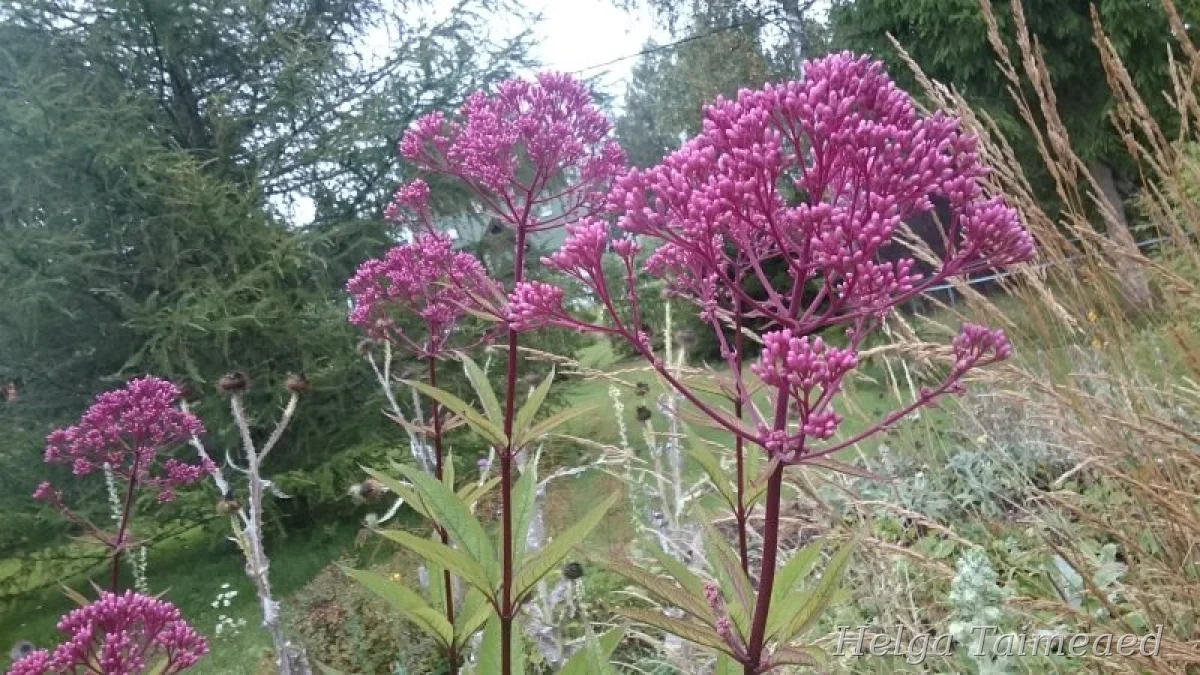
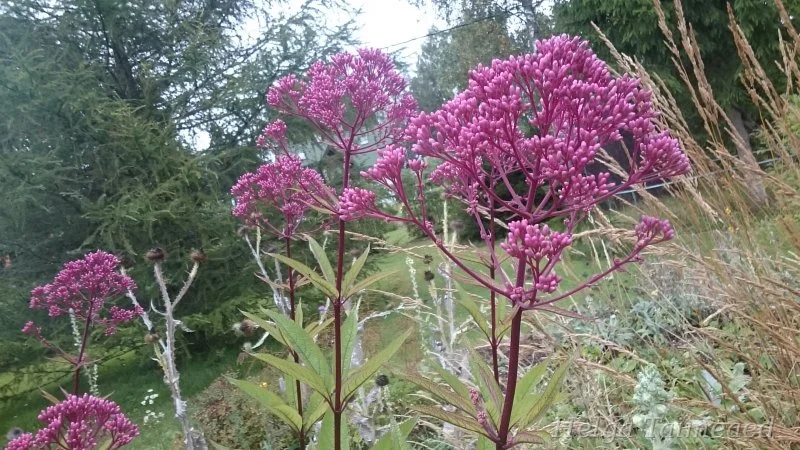
Tube-flowered waterhemp (Eupatorium fistulosum) variety 'Riesenchirm' - slightly shorter than the species, 150-180 cm high. Strong blackish-red shoots are very stable and can withstand quite strong winds. Dark pink flowers bloom in August and remain on the plant until frost. It takes a few years for a young plant to show its true beauty, but the joy of the magnificent plant increases over time. Prefers moderately moist and fertile soil, but also tolerates drought surprisingly well.
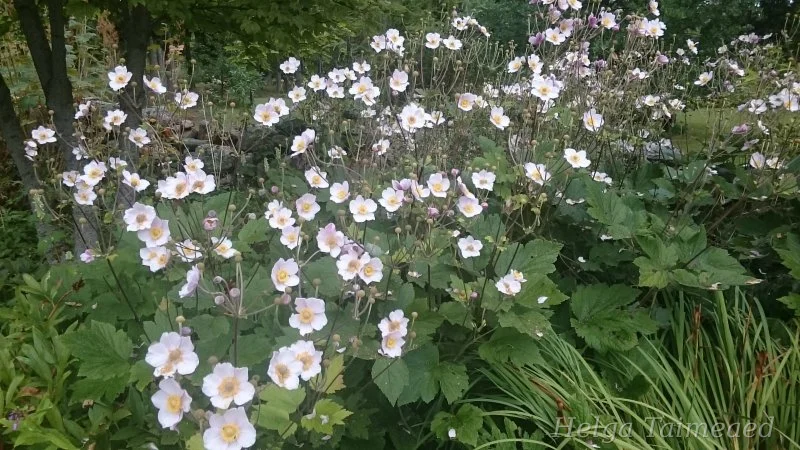
Felted anemone (Anemone tomentosa) is already known as an old farmhouse classic. Completely frost-resistant. Suitable for both sunny and semi-shaded growing in ordinary garden soil. In a large group, it makes a particularly beautiful spot in a perennial bed. Height up to 150cm - so it is also more suitable for a larger garden and the far edge of the planting area. Its flowering period is gratefully long - from July to frost and the inflorescences that have already finished flowering are also beautiful.
Hungarian honey thistle (Echinops bannaticus) is a 120-150 cm tall ornamental thistle with prickly greenish-gray foliage and blue flower clusters in the second half of summer. A real magnet for bees and butterflies. It likes fertile, well-drained, sunny locations best. It can also tolerate some partial shade. Thanks to its deep taproot, it can also cope well with drought.
Cluster heads need a moist and fertile growing location, preferably in partial shade, but a sunny location is also suitable if there is enough moisture.
The toothed lingonberry (Ligularia dentata) varieties 'Othello' and 'Destemona' have striking purple leaves when they bloom in spring, which, depending on the growing location, gradually grow to a height of 50-90 cm by the second half of summer. The strong purple flower stalks bear orange-yellow corollas at a height of 120-150 cm from July. Attracts a lot of bees and butterflies.
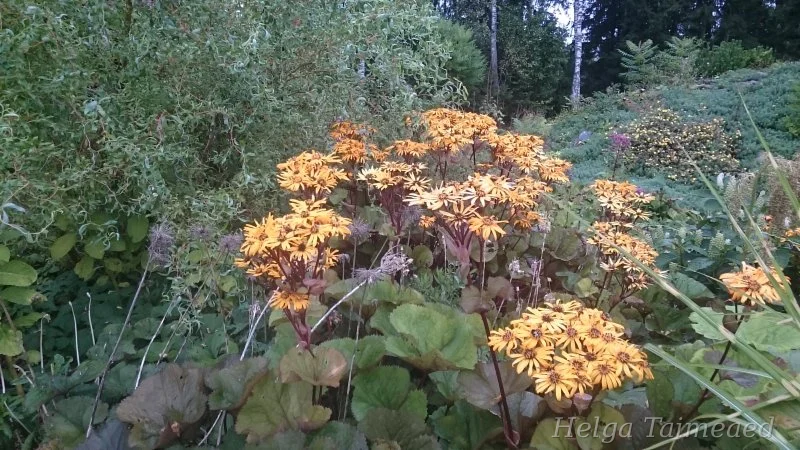
Ligularia palmatiloba (Ligularia palmatiloba)
A plant with large, deeply lobed green leaves and orange-yellow corollas. Height 180 cm when flowering. Leaves should be protected from snails.
Among the late perennials of medium height, we could highlight:
Turtle flower (Chelone) - it got its name from the flowers that resemble the head of a turtle with an open mouth. It comes from North America, where it grows in damp and even swampy areas. You have to be patient in the spring, because it sticks its nose out of the ground quite late. In the home garden, it also gets along perfectly well with completely ordinary, preferably nutrient-rich, moderately moist soil. Depending on the fertility of the soil, the height can be 50-100 cm.
Its varieties are also nice:
Tortoiseshell (C. obliqua) 'Alba' – pure white flowers on a background of dark green foliage. Height 90 cm.
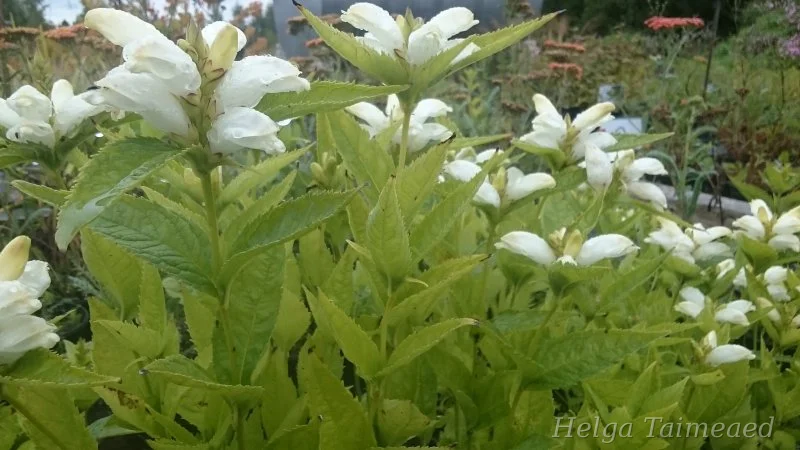
Oblique tortoiseshell (C. obliqua) 'Jenimienie' – a low and compact variety with pink flowers, height 20-50 cm.
Pink tortoiseshell (C. lyonii) 'Hot Lips' - bronze shoots, dark green foliage, pink flowers, height 60-90 cm.
The incised kalimeris (Kalimeris incisia) is an unjustifiably underused superflower. From late May to June, the plant is covered with lovely yellow-centered “astiri” flowers, and flowering continues throughout the summer. It is an undemanding and low-maintenance perennial. The best place to grow is fertile and permeable soil in full sun or partial shade. Butterflies like it very much. A properly rooted plant also tolerates drought well. As an undemanding plant, it is suitable for (too) moist to dry, alkaline to acidic, sandy to clay soil. Removing old flowers will extend flowering even further.
The variety 'Blue Star' has blue flowers with a diameter of 2.5 cm, a height of 40-50 cm
'Alba' White flowers, height 80 cm
'Shogun' has yellow-green variegated foliage, height 50 cm, the variegated foliage is most brilliant in a sunny and sufficiently moist fertile location. Pinching the tops further stimulates the growth of new bright shoots.
Common rock mint (Calamintha nepeta) is a plant with a mint-like scent and taste. A big plus is that it does not spread invasively across the bed like peppermint does. From June to September, the plant is covered with small flowers, which can be white to light purple depending on the variety. With a very pleasant aroma, bees really like it. A good flavor and tea plant. Undemanding, very good landscaping plant - tolerates both moisture and dryness equally well. If you cut it back when the flowering decreases, it will bloom again at the end of summer.
Varieties
'Triumphator' light blue flowers, height 40 cm
'Weisser Riese' white flowers, height 60cm
Redbuds (Sanguisorba) love to grow in a sunny or semi-shady, nutrient-rich and moderately moist growing location.
Narrow-leaved redbud 'Elephant' (Sanguisorba tenuifolia) From July to September, rich pink, slightly curved flower heads sway gracefully above the gray-green leaf sheath. Height 120 cm. Hardy and easy to grow.
The herbaceous redbud 'Tanna' (Sanguisorba officinalis') is more suitable for the edge of the bed. It is only 40-50 cm tall. Upright red flower buds from mid-summer to late summer.
Attracts bees and butterflies.
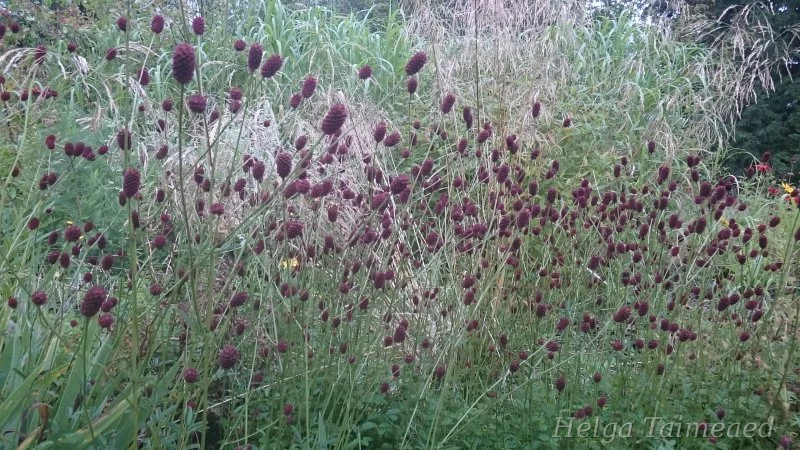
'Rock and Roll' is a new, richly flowering redbud variety. Height 75 cm. Airy, beautiful foliage topped with pink, upright flower buds from mid to late summer.
Three-stemmed silverleaf is a long-flowering plant for dry, well-drained sunny sites. Even in a little shade, the foliage loses its silvery color. A good plant for gravel and steppe gardens. Numerous clusters of 2 cm diameter flowers appear above the gray-green foliage from June. It is also a very good cut flower.
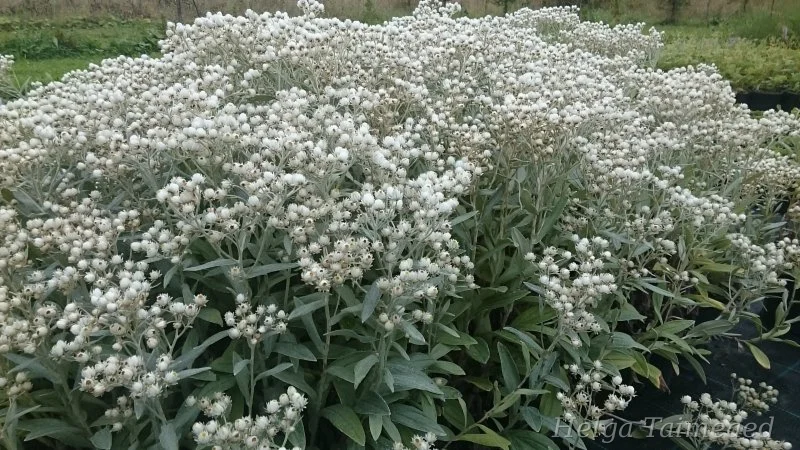
'Silberregen' height 30-40 cm
'Sommerschnee' height 20-25 cm
Grasses help create very nice communities in a perennial bed, and their beauty and change can be enjoyed mostly in the second half of summer, but not only. Very hardy and rewarding grasses are
Palm-leaved sedge (Carex muskingumensis) and its varieties
Molinia has many varieties with different flower head heights and structures.
Prairie fescue (Sporobulus heterolepsis)
Hairy Pipit (Luzula pilosa) 'Igel' and 'Grünfink'
Snow-whiskered grass (Luzula nivea)
Carpet fescue (Festuca gautieri) 'Pick Carlit'
Descampsia cespitosa 'Schottland', 'Goldtau'
Helictotrichon sempervirens 'Pendula', 'Saphirsprudel'
Green and glossy clover (Sesleria)
Loop foxtail ( Alopecurus pratensis) 'Aureovariegata'